Do Expeditions Include Kayak Gear? What’s Provided
October 13, 2026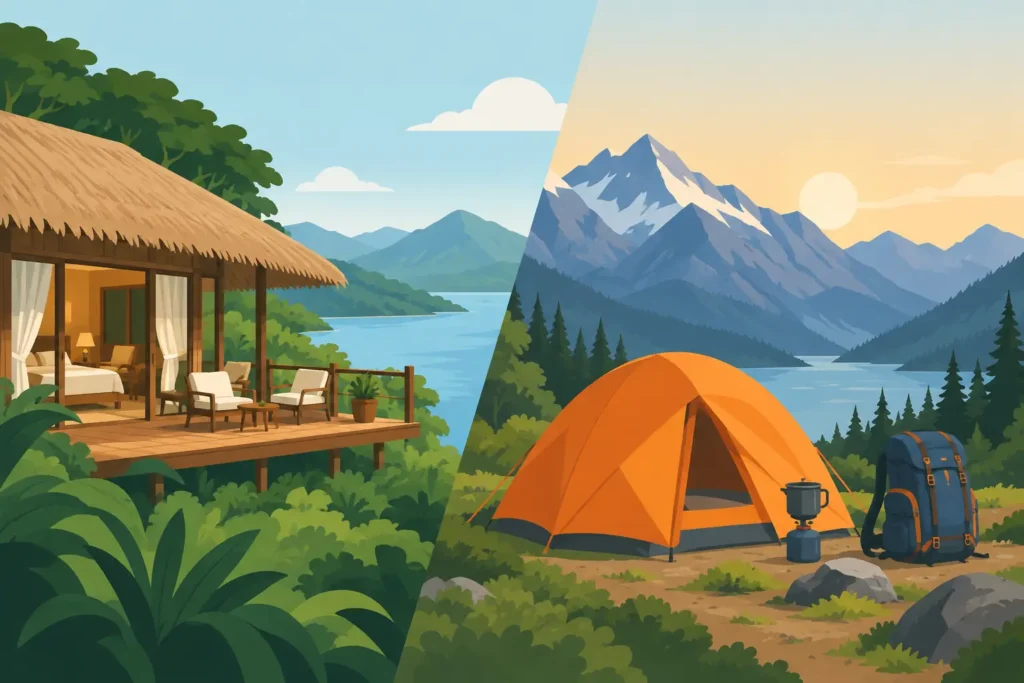
A jungle dawn can start two very different ways. You might step from a private cabin onto a deck with coffee in hand, listening to howler monkeys across the bay. Or you might unzip your tent at first light, hear paddle blades being readied on the beach, and feel the rainforest already moving around you. Both belong on a serious tropical adventure. The question behind ecolodge versus camping expeditions is not which style is tougher or more luxurious. It is which one puts you closest to the experience you came for.
For guided sea kayaking in Costa Rica and Panama, that choice shapes far more than where you sleep. It affects how remote you can travel, how much gear you carry, the rhythm of each day, and the kind of connection you build with the coast, rainforest, wildlife, and local communities.
Ecolodge Versus Camping Expeditions: The Real Difference
An ecolodge expedition uses carefully selected small lodges, cabins, or locally run properties as overnight bases. You still spend full days on the water, paddle wild coastlines, explore mangrove channels, snorkel, and watch for wildlife. At the end of the day, however, you have a proper bed, a shower, and a sheltered place to recover before tomorrow’s route.
A camping expedition places the overnight experience directly in the landscape. Your group may camp on a secluded beach, a designated coastal site, or a simple island camp reached only by water. Meals, tents, dry bags, and expedition equipment travel with the group or are staged by the support team. It is a more elemental way to move through a destination, and it can open up coastline that has no lodge at all.
Neither is automatically more authentic. A well-run ecolodge can create meaningful local connections and support conservation-minded communities. A well-managed camp can operate with minimal impact and exceptional care for fragile shorelines. The better choice depends on the kind of days – and nights – that make you feel most alive.
Choose an Ecolodge Trip for Recovery Without Missing the Wild
Ecolodge-based kayaking works particularly well for active travelers who want demanding, immersive days but do not want sleep deprivation to become part of the itinerary. Tropical heat, saltwater, sun exposure, and consecutive paddling days add up. A real mattress, dry clothing, dependable meals, and a comfortable place to recharge can make a major difference in how strong you feel on day four or day six.
This style is also a strong fit for couples, friends with mixed outdoor experience, and first-time expedition paddlers. You can take on a meaningful route without wondering whether you will sleep well in humid weather or feel comfortable managing camp routines. Expert guides still handle the complex pieces of a remote journey – route planning, tides, weather decisions, safety systems, boats, and local logistics – while the lodge provides a reliable reset at day’s end.
Lodge-to-lodge trips can also offer a richer range of regional experiences. One night might be in a quiet bay beside Golfo Dulce; another may put you near a community, forest reserve, or marine environment that would be difficult to reach on a standard beach camp. The accommodation is not just a comfort feature. When chosen well, it becomes part of the route.
There are trade-offs. Lodges set the daily rhythm more than a mobile camp does. You may paddle into an exceptional wilderness area but return to a developed base rather than sleeping directly beneath the stars. Some properties, even excellent ones, are accessible by road or boat traffic. If your goal is total isolation, camping has the edge.
Choose Camping for Full Expedition Immersion
Camping is for travelers who want the trip to feel like a true journey across the landscape rather than a series of day adventures from comfortable bases. When your campsite is the destination, the evening becomes part of the expedition. You may swim after a long paddle, watch pelicans settle into the trees, share dinner as the tide rises, then fall asleep with the sound of waves just beyond the tent.
It also delivers a rare kind of access. Remote beaches, uninhabited islands, and protected stretches of coast often have no permanent accommodation. Camping allows a guided group to travel through these places respectfully, carrying what is needed and leaving the site clean. For sea kayakers, it creates a satisfying continuity: you launch from the shore where you slept, move under your own power, and arrive at a new camp shaped by the day’s route.
That said, camping should never mean roughing it without a plan. On a quality guided expedition, essential comfort and safety details are managed professionally. You need reliable tents, dry storage, clean water systems, thoughtfully prepared meals, clear sanitation procedures, first-aid capability, weather monitoring, and guides who know when conditions require a route change. Good expedition camping feels simple, not careless.
The trade-off is predictable: nature does not provide a climate-controlled room. Humidity, wind, nighttime sounds, sand, and occasional rain are part of the experience. Bathrooms may be basic. Privacy is lower. If you are already carrying fatigue from a busy life or you know poor sleep affects your enjoyment, an ecolodge itinerary may give you a better trip overall.
Wildlife Is Not About the Bed You Sleep In
Travelers often assume camping guarantees better wildlife and ecolodges mean a less wild experience. That is too simple. Wildlife encounters depend most on the destination, season, route, timing, guide knowledge, and how quietly your group moves through the environment.
A Tortuguero-style paddling journey, for example, can bring you close to monkeys, caimans, tropical birds, and river life from the kayak itself. A lodge near the water may allow early starts when wildlife activity is high, plus time to observe the forest between paddling sessions. In Golfo Dulce, a lodge-to-lodge route can place you along one of Costa Rica’s most biologically rich coastal regions while preserving the energy needed for full days of exploration.
Camping does create more time in the transition periods when wildlife is often most active: dawn, dusk, and the quiet hours after paddling ends. But it also requires disciplined camp behavior. Noise, lights, food handling, and campsite selection matter. A responsible guide team protects both guests and habitat by treating wildlife viewing as observation, never pursuit.
Consider Your Trip Priorities, Not Your Outdoor Resume
Do not choose camping simply because you think an adventure traveler is supposed to camp. And do not choose an ecolodge because you assume it will make the trip easy. Both can be physically active, remote, and deeply rewarding.
Start with how you want to feel at the end of a full paddling day. If your ideal evening includes a hot shower, a solid meal, and a comfortable bed before another ambitious day on the water, choose an ecolodge expedition. If your ideal evening is setting up camp on a quiet shore and feeling fully removed from roads, schedules, and buildings, choose camping.
Also consider who you are traveling with. A mixed-ability group may be happiest on an ecolodge itinerary because recovery is more predictable. Experienced campers and travelers who value self-sufficient travel may find the camp routine adds purpose and camaraderie. A guided operator should be candid about physical demands, campsite conditions, bathroom access, heat, paddling distances, and what happens when weather changes the plan.
The Best Option May Be a Hybrid Itinerary
Some of the strongest expedition designs use both. A few nights in an ecolodge can provide a comfortable start, a chance to settle into the climate, and an opportunity to enjoy a region’s food and hospitality. Camping nights then take the group farther into the wild, where lodges cannot go. The sequence gives you both recovery and remoteness without forcing the entire trip into one style.
This approach is especially valuable in Central America, where a short distance can lead from rainforest-fringed villages to uninhabited coastlines. Sea Kayaking Costa Rica builds its guided experiences around the character of each destination rather than imposing one accommodation style everywhere. The route should lead the decision.
Before booking, ask direct questions about the overnight setup, not just the day-by-day highlights. What are the actual sleeping arrangements? How are bags transported? What is the rain plan? Is there a shower or freshwater rinse? How private are campsites? What level of paddling is expected after a night outdoors? Clear answers are a sign that the expedition has been designed with care.
The right trip is the one that leaves you eager to launch each morning. Whether that starts from a secluded tent or a rainforest ecolodge, the best expeditions make the coast feel bigger, wilder, and more personal with every paddle stroke.